
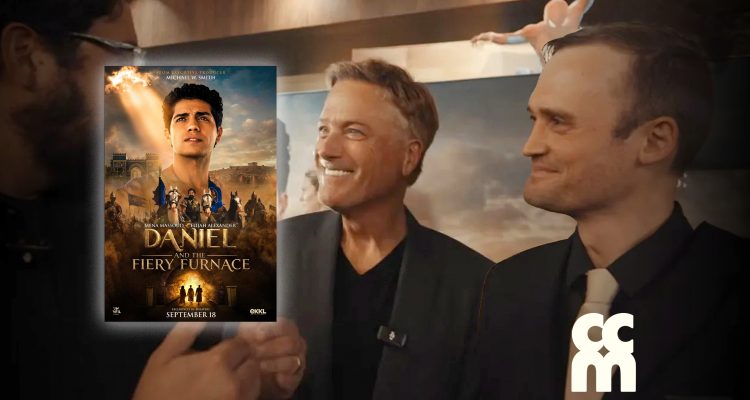
There are certain Bible stories you have seen illustrated so many times that you almost forget you have never actually seen them.
Shadrach, Meshach and Abednego in the fiery furnace is one of those stories.
This week we got that chance to attend the premiere of Daniel and the Fiery Furnace, the latest theatrical release from EKKL Entertainment. And if the atmosphere surrounding the premiere was any indication, there is a lot of passion behind this one.
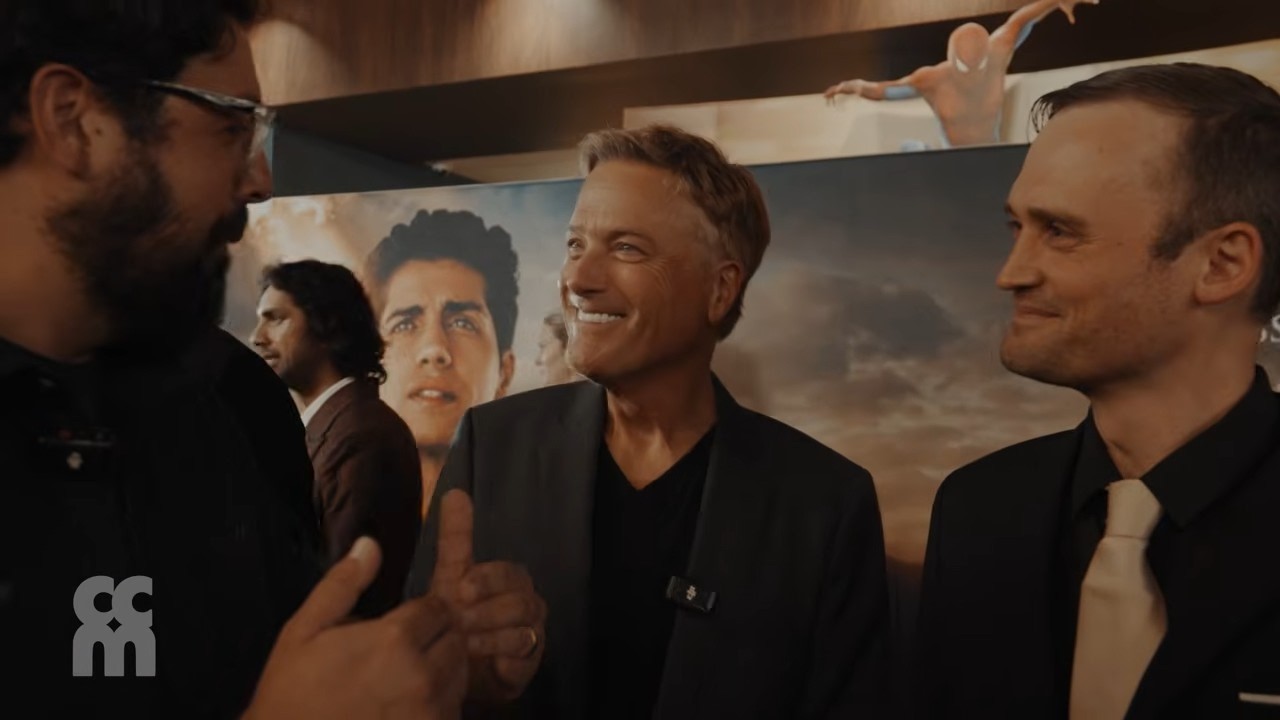
Before we get into the movie, check out our red carpet highlights below. We caught up with CCM favorites Michael W. Smith, Aaron Shust, Trevor McNevan of Thousand Foot Krutch, Tommee Profitt and several members of the cast and creative team. And stay tuned, because we have much more coming from those conversations.
Directed by brothers Matthew and Daniel Kooman, Daniel and the Fiery Furnace takes us into the opening chapters of Daniel and the Babylonian exile, with Aladdin star Mena Massoud stepping into the role of Daniel and The Chosen‘s Elijah Alexander trading his familiar role as Atticus Aemilius for the considerably bigger robes of King Nebuchadnezzar.
And those two are the reason this movie works as well as it does.
But wait… Daniel Isn’t in the Fiery Furnace
First, let’s deal with the title.
If you know your Bible, Daniel and the Fiery Furnace might initially cause a little head scratching. Daniel, of course, isn’t one of the guys who gets tossed into the furnace. That distinction belongs to Shadrach, Meshach and Abednego.
But the movie isn’t simply retelling the furnace story. It is telling the larger story surrounding it, adapting the first three chapters of Daniel and establishing Daniel’s relationship with Nebuchadnezzar, his friends and the empire in which these young men suddenly find themselves living.
Once you see the movie, the title makes considerably more sense. This is Daniel’s world, and the furnace becomes the defining test of faith within it.
Mena Massoud is probably the face most mainstream audiences will immediately recognize. He starred opposite Will Smith as Aladdin in Disney’s 2019 live-action remake, and here he brings a real emotional strength to Daniel. As a dad of twin girls who were the perfect age when Aladdin came out, I’ve probably seen Massoud’s performance hundreds of times at this point. So I already knew what he could do and I wasn’t surprised when he absolutely knocked it out of the park.
I was less familiar with Elijah Alexander coming into this film and he blew me away. He delivers an award worthy performance. Alexander, who viewers of The Chosen know as the Roman investigator Atticus, gives Nebuchadnezzar far more humanity than the standard Bible-movie villain treatment.
His Nebuchadnezzar is powerful, intimidating and deeply proud, but Alexander also finds the insecurity underneath all of it. This is a king with a fragile ego, and occasionally one who is more relatable than you might expect him to be.
That makes his relationship with Daniel fascinating.
Alexander and Massoud have undeniable chemistry, and the movie is at its strongest when the two of them are simply allowed to play opposite one another. You begin to understand why Nebuchadnezzar would be intrigued by him, trust him, become frustrated with him and, at times, seemingly have no idea what to do with him.
Alexander and Massoud don’t play these roles as Sunday School cartoons. They play them as humans. That’s much more interesting.
The film was shot on location in India, and visually, Daniel and the Fiery Furnace doesn’t always attempt the ultra-polished photorealism we have come to expect from $200 million Hollywood productions.
There are moments where the effects or production design reveal the realities of making an ambitious biblical epic without an unlimited budget.
Oddly enough, I didn’t always mind it.
At times, the movie takes on an almost painted quality. Babylon can feel slightly heightened or dreamlike, which actually works with material most of us have spent our entire lives visualizing only in our imaginations. We don’t actually know what Daniel’s world felt like from moment to moment. We have Scripture, history and archaeology, but every illustrated Bible, and sermon has helped us build our own mental version.
The film gives those names faces and those places walls without completely robbing the story of that imaginative quality. I also appreciated the filmmakers’ willingness to let the ancient world sound different from ours. While the movie is largely in English, other languages weave their way through the story, including Hebrew in moments of prayer. Those touches help remind us that these weren’t English-speaking Bible characters waiting around to deliver familiar lines.
They were people displaced into a foreign empire.
There is also a surprisingly strong CCM connection running through this entire production.
Michael W. Smith serves as an executive producer, but his involvement actually began with his son, composer Tyler Michael Smith.
Tyler wrote the film’s original score, and Michael has said he first encountered the project while watching his son work on the music. What he heard, and then what he saw of the movie, convinced him there was something special happening here.
It’s a pretty great full-circle moment for anyone who knows Smitty’s love of cinematic music.
And then the credits roll. Suddenly Trevor McNevan of Thousand Foot Krutch and TobyMac come crashing into ancient Babylon with “Walk Thru Fire.”
That should absolutely not work. You have just spent nearly two hours in a biblical period piece and suddenly Christian rock’s most recognizable voices arrives.
And then… boom. It works.
“Walk Thru Fire,” written by McNevan and produced by McNevan and Micah Kuiper, plays over the end credits and somehow pulls the themes of the film directly into the modern world.
It is a reminder that the furnace is not really the point of the story.
Faithfulness when you’re standing in front of it is.
Part of the fun for us was getting to experience this one with the people who made it.
The Franklin premiere had that increasingly rare feeling where cast, crew, musicians, friends and family weren’t simply showing up to promote a product. You could feel how personally invested many of them were in what was on the screen.
Biblical filmmaking is difficult.
Audiences already know the ending. Many know individual verses by heart. Everyone has their own mental picture of what these people looked like and how these moments unfolded.
Daniel and the Fiery Furnace doesn’t attempt to reinvent the reason these stories have endured for thousands of years.
Instead, it gives us an opportunity to sit in a dark theater and experience them again.
And when Shadrach, Meshach and Abednego finally stand before that furnace, knowing exactly what comes next doesn’t make the moment any less powerful.
Daniel and the Fiery Furnace opens in theaters September 18. Keep watching CCM Magazine for much more from our red carpet conversations with the cast, filmmakers and artists behind the movie.
Leave a Reply
You must be logged in to post a comment.