
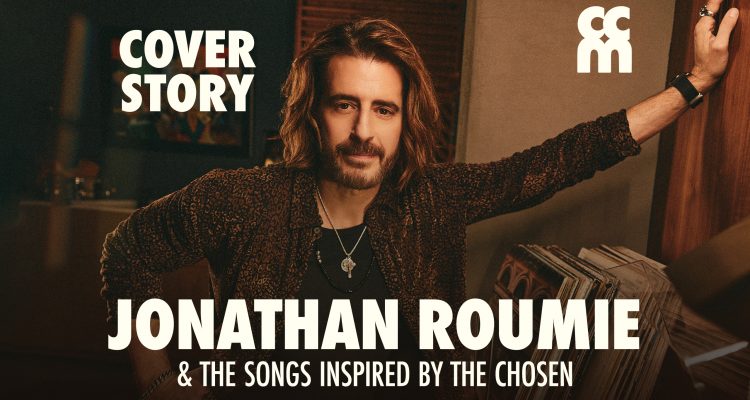
“Season six (the crucifixion) was the most amount of sacrificing of my own identity in a role than anything I’ve ever done previously in The Chosen or anything else in my life, and it extended beyond work, beyond filming and playing a character.”
Jonathan Roumie pauses before explaining just how far that sacrifice went.


“I’d be in church and I’d look at a crucifix and I just start weeping because I’d been at that vantage point trying to convince my brain that that was happening to me. And then now it’s like, how do I how do I let go of that? It’s like there’s an element of PTSD that is very, very real.”
It’s a remarkable admission from the actor who has spent nearly a decade portraying Jesus Christ on The Chosen.
“It’s a hard thing to explain to people because it just sounds like to me, it sounds like I must be insane.”
I couldn’t help but point out the irony. People routinely approach Roumie and spontaneously burst into tears themselves. I’ve seen it happen. If anyone might understand the emotional weight of this character, it’s the millions of viewers who have spent years welcoming his portrayal of Jesus into their homes.
But I was also beginning to understand something else. Beneath the long hair, the beard, and that instantly recognizable face was a man who had given an extraordinary amount of himself to a role that had become bigger than any actor.
And now, for the first time in nearly eight years, he was figuring out how to let it go.
Of course, just 30 days earlier, I wouldn’t have fully understood any of this.
Because I hadn’t actually watched The Chosen.
“My face may fade from people’s mind over the years, and that’s great. But hopefully as my face fades, their hearts grow more deeply in love with Jesus.”
– Jonathan Roumie

When Jonathan Roumie confirmed he would be our November CCM Magazine Cover Story, I knew there was something I had to do. I had 30 days to watch the entire series.
Despite the show’s extraordinary success and seemingly endless presence in my social media feeds, my actual exposure to The Chosen consisted of its first episode and an endless number of Instagram Reels.
Why hadn’t I sat down and given this phenomenon its due?
I’d like to believe it was God’s timing. But if I’m being completely transparent, I think there might have been a little jealousy involved, too.
Creator and director Dallas Jenkins and I don’t have terribly different backgrounds. We’re both filmmakers who have spent years navigating the unpredictable world of independent Christian entertainment, including a few feature films that didn’t exactly achieve box-office domination.
“He’s always within and he’s part of my every moment of my waking life. And part of my consciousness at all times. But I think what I mean by the projection is everybody else imposing that upon me when they see me or meet me.”
– Jonathan Roumie
So when The Chosen started gaining traction, perhaps there was a small, admittedly sinful part of me that wondered why his project had connected in a way so few others ever had.
Perhaps some of it was the controversy, too. For years, my YouTube feed seemed filled with people debating the show’s theology or questioning its creative decisions. Instead of watching the actual show, I’d allowed everyone else’s opinions to take its place.
What made this even stranger was that I was already a fan of Jonathan Roumie. Just not as Jesus.
I knew him from Jesus Revolution, where his portrayal of the late Lonnie Frisbee was one of the film’s most compelling performances. I also enjoyed his comedic chops attempting to help Kevin James recover from being left at the altar through a beautiful trip through Italy in Solo Mio. To me, Jonathan Roumie wasn’t Jesus. He was a talented character actor with impressive range and a fascinating career. But I’d seen how other people reacted to him.
I’d attended a Christmas party where Jonathan was a guest and witnessed what happens when people encounter the man they’ve spent years watching portray the Son of God. For some, it’s an emotional experience that defies explanation.
There have been countless portrayals of Jesus Christ on film and television, but something about Roumie’s performance has connected differently. His face, his mannerisms, the strength and gentleness of his voice, and even the humor he brings to the character seem to align with an image of Jesus that so many people have carried in their minds for years. And unlike a traditional biblical film, which might offer two hours with an actor in the role, The Chosen has allowed audiences to live with this portrayal for years.
So I started watching.
And kept watching.
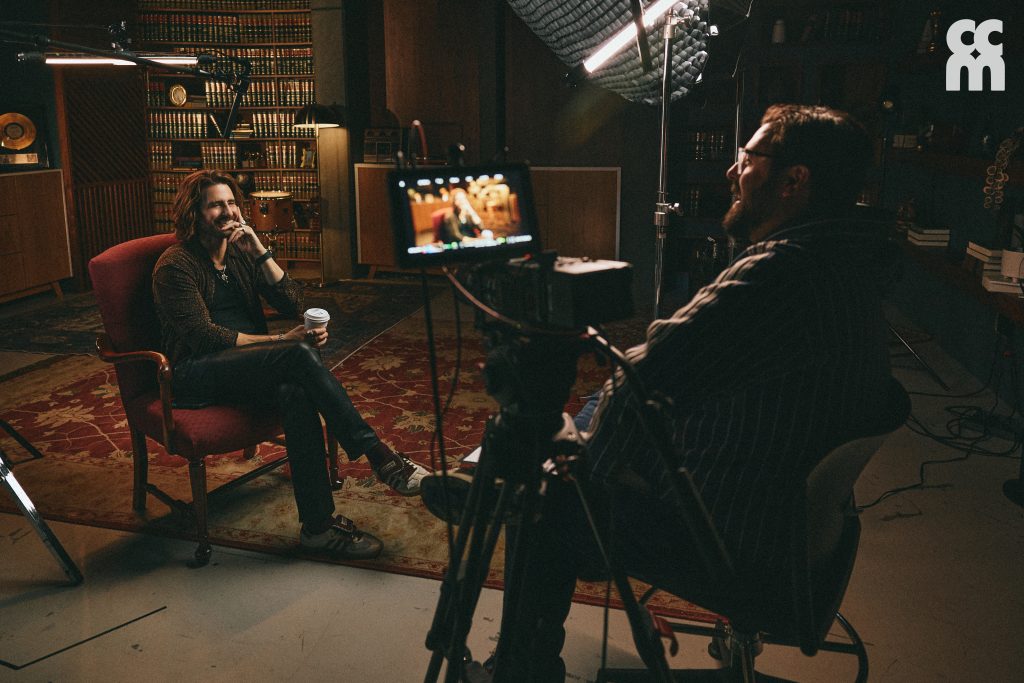
Forty-three episodes later, I found myself sitting across from Jonathan Roumie with an entirely different understanding of both the series and the Gospels. In just 30 days, the way I visualized the New Testament had been permanently altered.
I’ve traveled to Israel many times. I’ve walked through the locations where these events unfolded. I’ve known these stories my entire life. But seeing them brought to life through hours of carefully crafted storytelling gave me a new frame of reference. Some scenes unfolded exactly as I’d imagined. Others challenged images I’d carried since childhood. The disciples became more than familiar names on a page. They became people. I found myself caring about them in ways I hadn’t anticipated.
And somewhere along the way, Jonathan Roumie became the face of Jesus in my mind, too.
Which created a new concern.
Was I going to spontaneously burst into tears when I met him this time?
I’m happy to report that I did not.
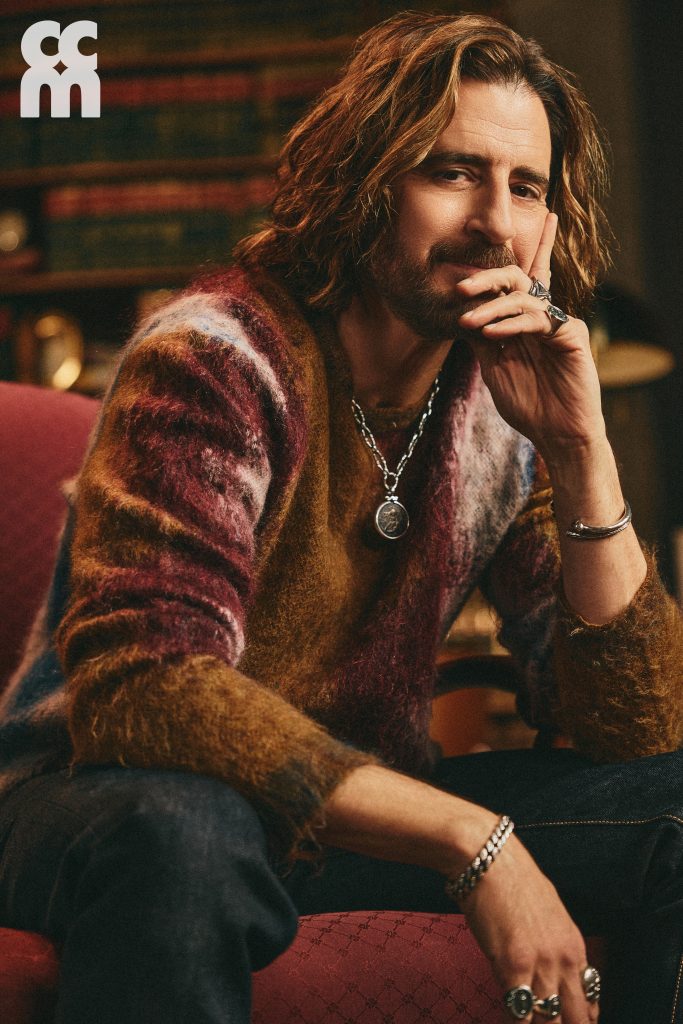
Because while Jonathan Roumie is a deeply committed man of God, he is, at the end of the day, a man. An actor. A fellow film-school nerd. A rock drummer. A somewhat poetic, eccentric artist who grew up loving rock and roll and dresses like he might be the frontman.
In other words, someone I could relate to perhaps even more than the characters he’s portrayed.
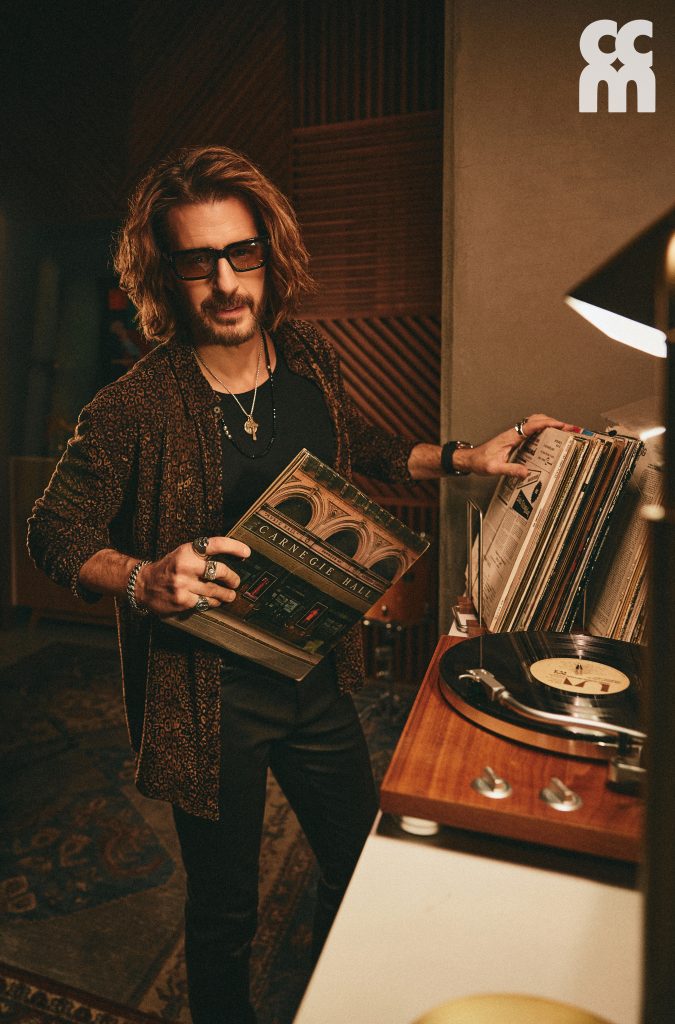
And for CCM Magazine, that opened up an entirely different conversation.
Long before Jonathan Roumie became one of the most recognizable faces in faith-based entertainment, he thought he might spend his life behind a drum kit.
“I was born in the 70s and I grew up in the 80s,” Roumie tells me. “I think popular music was just a lot more melodic.” He remembers an era when bands dominated the radio and instrumentalists were at the center of popular music. “And back then, when I grew up, all of this amazing music was just everywhere on the radio. And you can you could find it at any time.” But for Roumie, music wasn’t simply something to listen to. He seriously considered making it his career.
“I went to film school but while I was in film school I started playing with an artist and we recorded an album. And I thought I would tour. I thought I was going to possibly become a drummer professionally.”
It wasn’t merely a fantasy. The album was recorded and released, and touring plans were beginning to take shape. Then came the kind of announcement that can derail an entire career.
“After we cut this album, we started scheduling dates and talking about a tour, and then the record company said, hey, by the way, we’re bankrupt. We don’t have any money, so there’s not going to be a tour.” The record was already on shelves. “So enjoy the record, you know? And so the record was out in like Tower Records and Virgin and all these record stores and was like, great, awesome. Now we can’t even go sell them.”
But before that musical chapter closed, he’d managed to accomplish something that any rock fan would recognize as a milestone.
He played CBGB’s.
For anyone who grew up loving punk rock, the legendary New York venue occupies a sacred place in music history. The Ramones, Misfits, New York Dolls, Blondie, Talking Heads, and countless others helped establish its reputation.
“That’s one of my bucket list moments,” he recalls. “Not even realizing it was going to be a bucket list.” When the club eventually closed, he realized just how special that experience had been. Which brings us to one of the more unlikely musical journeys I’ve ever encountered.
Here was a guy who played drums at CBGB’s, watched his touring career evaporate, spent years working behind the scenes in Hollywood, and eventually became the face of Jesus to millions.
“To see now an entire album, full of these fantastic, amazing, super talented musicians and artists and singers and writers just being inspired by the show to create their own music and put their own stamp on their experience of our art, of our version of those those paintings and those pictures… it’s humbling and it’s it’s exciting. We inspire each other.”
– Jonathan Roumie
Now, on November 29, he’s preparing to take the stage at Carnegie Hall alongside Christian recording artist and friend Matt Maher. From CBGB’s to Carnegie Hall. Even Roumie seemed surprised when I connected those dots.
“Yeah, well, that’s God, isn’t it?”
He continued:
“That’s just how God works. And it’s I, I hadn’t even really thought about that connection until you just brought that up. So kudos to you, man. I have no explanation. That’s just Jesus. That’s just God, you know, like, he knew that even though the tour never took off, that it wasn’t gonna stop him from eventually getting me to these places.”
The Carnegie Hall event will feature Roumie narrating the Christmas and Advent story, accompanied by a full orchestra and a massive choir.
And even after all these years, the drummer in him hasn’t completely disappeared.
“Matt Maher is a really close buddy of mine. And I said, look, just let me sing one note. I have to be able to say that I sang at Carnegie Hall.”
Perhaps the most fitting part of Roumie’s musical journey is that the very television series that changed his acting career is now inspiring music of its own.
Songs Inspired by The Chosen brings together an extraordinary collection of artists from contemporary Christian music and beyond, including Phil Wickham, Jamie MacDonald, Lady A, Boyz II Men, Tyler Hubbard, Franni Cash, Blessing Offor, and more.
For CCM Magazine, it’s a particularly exciting intersection of the worlds we’ve spent decades celebrating: faith, music, and storytelling.
And there’s something wonderfully full-circle about the former rock drummer watching other musicians respond to a performance that might never have existed had his original music career gone according to plan. During our conversation, I asked Roumie what it was like, as a musician himself, to see artists translating their experiences with The Chosen into songs. His answer went somewhere unexpected. Renaissance paintings.
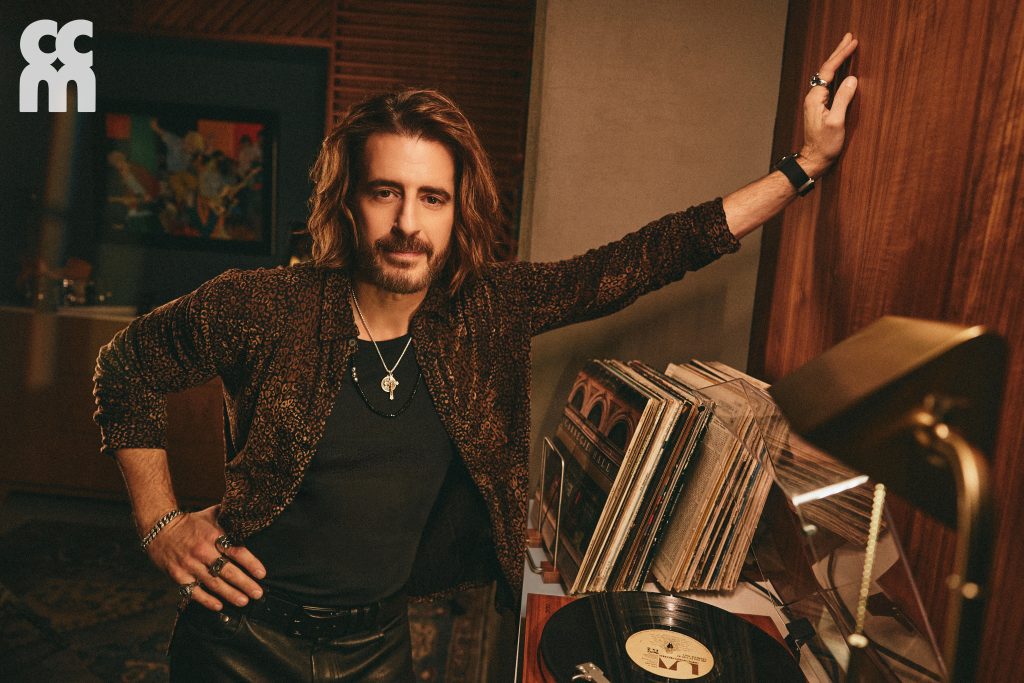
“I think it’s just the, the tradition of inspiration that artists have had over the centuries,” he explains.
Roumie points to the works of classical painters whose visual language helped shape the show.
“Caravaggio was a big driving image based force for the cinematography in the show.”
Roumie himself drew inspiration from religious paintings when developing the physical language of his portrayal. “Some of the poses that that he depicts, Jesus. And I would incorporate them into a scene in, in, you know, just in my own sort of body as a sort of a reference and a and a respect and an honoring of what came before us.”
It’s a fascinating revelation. Some of the images that make Roumie’s portrayal feel familiar aren’t necessarily accidental. He’s consciously drawing from centuries of sacred art, bringing those influences into a modern television production. Now musicians are taking inspiration from that production to create something new.
“To see now an entire album, full of these fantastic, amazing, super talented musicians and artists and singers and writers just being inspired by the show to create their own music and put their own stamp on their experience of our art, of our version of those those paintings and those pictures… it’s humbling and it’s it’s exciting. We inspire each other.”
That idea is at the very heart of Songs Inspired by The Chosen. A television series rooted in Scripture and influenced by centuries of sacred imagery has now inspired musicians to tell those stories through an entirely different medium.
Music can carry an emotion or an experience beyond the confines of a television episode. A song allows listeners to return to that feeling wherever they are. It’s why this project feels especially appropriate for CCM Magazine. And throughout our November Cover Story celebration, we’ll bring that musical connection to life with exclusive performances from Franni Cash and Blessing Offor.
But as our conversation continued, we began moving from the music and artistry of The Chosen toward the far more complicated experience of being the man at the center of it all.
Audiences have become so attached to Jonathan Roumie’s portrayal of Jesus that, for millions, it’s nearly impossible to imagine anyone else in the role.
Even my own mother apparently feels that way.
I shared a story with Jonathan about an audition I had a few years ago for an animated film about Jesus that ultimately never got made. I recorded my audition and sent it to my mom for her thoughts. Her response?
“Why didn’t they just ask Jonathan to do this?”
Thanks, Mom. Roumie laughed, but quickly acknowledged the double-edged sword of becoming so closely associated with the Son of God.
“Because then it’s like how somebody gets pigeonholed. Does somebody become indistinguishable from having actual divine properties and powers as a human being or not or will that be the only character people expect me to play is a version of Jesus?”
To become so convincing in a role that audiences struggle to imagine anyone else playing it is perhaps the ultimate compliment. But when that role is Jesus Christ, the line between admiration for the performance and expectations placed on the performer can become dangerously blurred.
After nearly eight years, maybe a dramatic makeover was in order. Were we cutting the hair? Shaving the beard? Doing something drastic to disconnect? I asked this question with sarcasm, but received an entirely well thought out response.
“Every season, not too long after we’d wrap, I would shave the beard and I would cut the hair. It’s just to disconnect from the projection of the image of Christ onto me.” That distinction matters. Roumie isn’t trying to distance himself from Jesus. He’s trying to create some separation between his faith and the image that other people project onto him.
“He’s always with me, and he’s part of my every moment of my waking life. And part of my consciousness at all times. But I think what I mean by the projection is everybody else imposing that upon me when they see me or meet me.”
For an actor whose breakthrough arrived after years of wondering whether conventional Hollywood success would ever come, it’s an unusual challenge. “I had accepted the fact that that probably wasn’t going to be the Hollywood kind of ideal was not in the cards for me. And it still isn’t.” He knows major Hollywood stars personally, but those relationships haven’t necessarily translated into the opportunities people might assume have followed his success.
“As far as like, you know, auditioning for a arvel film or anything like that, like that’s never happened.”
And surprisingly, he doesn’t seem particularly bothered by it.
“Since The Chosen, I no longer am sort of pinning any hopes on what I thought was a fulfilling career, because that’s completely changed now. My fulfillment is in serving the Lord, using the gifts and talents that he gave me.”
That perspective doesn’t mean he’s done telling stories.
Roumie revealed that he’s actively developing two television series, both very different from The Chosen but rooted in the kind of meaningful storytelling he wants to continue creating.
“I’m actively developing stories myself and I’ve got teams on two different TV series that are completely different, but not violating the the sensibility of what people have come to see me play.” It’s also worth remembering that Roumie spent 12 years in film production before moving into acting full-time. He understands the filmmaking process from both sides of the camera.
That experience helped shape his relationship with The Chosen creator Dallas Jenkins, with whom he’d worked on short films for several years before the series began.
“I trusted him as a director implicitly, as a writer implicitly,” Roumie explains. “And then he trusted me as an actor.” Their creative conversations sometimes involved questioning whether a line of dialogue might be better expressed through a gesture or a visual moment. “At the end of the day, though, the best idea wins.”
For someone who has spent nearly a decade helping audiences see Jesus, perhaps the next great challenge is allowing them to see Jonathan Roumie again. But reclaiming that identity has been anything but simple as we are about to all witness the climax of the series. The crucifixion of Jesus Christ.
“It was impossible. It was an impossible thing. It was impossible. Like it felt impossible. We did it. So it wasn’t impossible, but it felt impossible.” That’s how Jonathan Roumie describes filming the crucifixion. Production traveled to Matera, Italy, for three weeks that he describes as the most difficult of the entire series.
“It was the hardest season for everybody involved, from top to bottom.”
The crew faced language barriers, limited time, and the usual frustrations of an ambitious production working in a foreign country. But those logistical difficulties were compounded by the subject matter itself.
“We knew it was going to be tough. We didn’t know it was going to be that tough.”
The emotional preparation had actually begun much earlier. Roumie recalls being asked about filming the crucifixion as far back as Seasons Two and Three. At the time, it seemed so far away that he couldn’t even begin to contemplate the experience. By the time Roumie reached the crucifixion itself, the emotional demands had gone far beyond what he’d experienced in previous seasons.
As he shared at the beginning of our conversation, those feelings didn’t simply disappear when the cameras stopped rolling. He found himself unexpectedly crying in church, struggling to separate his own emotional experience from the character he’d spent years embodying.
But as we all know, the story didn’t end there.
With the filming of Season Seven came the resurrection, and with it, a very different experience for Roumie as an actor.
“Having the joy of the resurrection for the filming of season seven and the fun of being back with the disciples and, and my mother and just the joy of that season, made it so much, so much easier to kind of re sort of reemerge for, for for Jonathan to reemerge, if that makes sense.”
It reminded me of hearing The Beatles discuss the recording process of Abbey Road. The final time they were all together after the chaos of the Let It Be recording sessions. They knew it was wrapping up and could be a band again for a moment. There’s something beautifully poetic about the resurrection helping the actor reclaim his own identity after experiencing the suffering of the crucifixion. When I asked the question that has been asked of him ad nauseam his answer was remarkably simple. What was his faith like now compared to day one?
“Just more intimacy with with God and with the saints and with, you know, my guardian angel and and with the faith and with the the fullness and the the treasury of the faith and and wanting to know more and wanting to understand more.” Even after years spent portraying Christ, Roumie still sees himself as a student. “If I knew three seasons ago what I know now, I might have played scenes differently.”
He hopes that relationship with God continues to deepen, describing his desire to keep learning, asking questions, and growing in faith. And perhaps that’s where this entire experience comes full circle.
When I began my 30-day journey through The Chosen, I expected to prepare for an interview. Instead, I found myself looking at the Gospels differently, becoming emotionally invested in people I’d read about my entire life.
The cast, creators, and music of The Chosen helped transform those familiar biblical figures into real, flesh-and-blood human beings in my imagination.
It also reminded me why I fell in love with storytelling in the first place.
For all my years in filmmaking, and all the time I’ve spent surrounded by Christian music and entertainment, I’d somehow managed to overlook one of the most extraordinary examples of what those creative gifts can accomplish.
As we wrapped our conversation, I pointed out something that separates this role from almost every other character in television history.
When the credits roll on the series finale, we don’t actually have to say goodbye to Jesus.
The story continues long after the television show ends.
And for Jonathan Roumie, that seems to be the entire point.
“My face may fade from people’s minds over the years, and that’s great. But hopefully as my face fades, their hearts grow more deeply in love with Jesus.”
EDITOR’S NOTE —
Songs Inspired by The Chosen is available now wherever music is streamed or sold.
Season 6 Premieres November 15 on Prime Video… and we’ve got more to come!
Our conversation with Jonathan Roumie continues with an additional, currently embargoed portion of this CCM Magazine Cover Story. We’ll release that spoiler-filled conversation after the first episodes of Season 6 release on November 15.
Leave a Reply
You must be logged in to post a comment.