
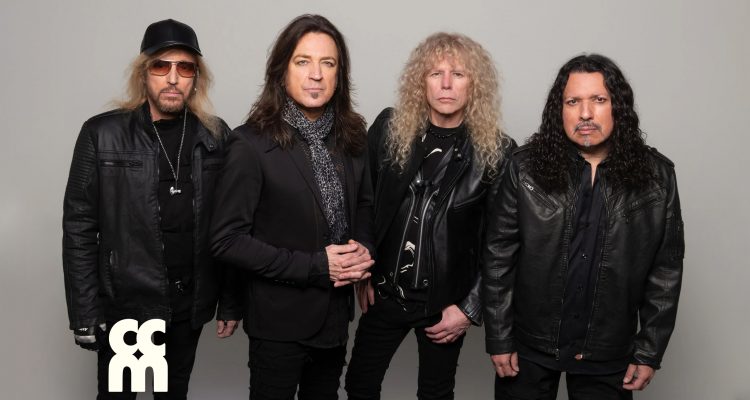
Why are you still making new albums? The economics have changed. Album sales certainly aren’t what they once were. For a band with a catalog stretching back more than 40 years, there is a perfectly viable business model that involves getting on a bus, playing the songs everyone already knows, selling some shirts and going home.

Stryper could absolutely do that. Instead, on September 25, they are releasing their 18th studio album, Throne of Thorns. After listening to the record and sitting down with brothers Michael and Robert Sweet, I think I understand why. They still love doing this.
That sounds simple, but Throne of Thorns sounds remarkably uninterested in being a nostalgia exercise. It is a rip-roaring rock record. It is heavy, melodic and full of the guitar harmonies, huge vocals and occasionally ridiculous level of musicianship you expect from Stryper.
“If you don’t [love it], then you’re not going to be as productive,” Michael told me. “You’re just not going to have that passion and that desire and that drive.”
There is always a temptation for a band with this much history to prove it can sound current by chasing whatever “current” happens to mean that year. Michael readily admits Stryper has experimented with that over the years. Eventually, you have to remember what made people care about your band in the first place.
“You try to reinvent the wheel, you try to be this new invention of yourself when you realize at some point, why are we doing that?” Michael said. “Some bands try to go somewhere else and get too modern, and they lose sight of what put them on the map.”
Robert sees Stryper’s identity as something almost impossible to escape. “You always have your elements,” he told me. “You are yourself, so you can’t really escape yourself.”
For Stryper, that includes those instantly recognizable harmonized guitars. “That’s just Stryper,” Robert said. “Mike and I sat down and went, ‘Okay, this is going to be a signature part of our sound.’” You hear that all over Throne of Thorns.
This won’t be a track by track breakdown, but I will give you some of my highlights. “Hollywood,” one of the immediate standouts for me. For a band whose history is so intertwined with the Sunset Strip, the song allows Stryper to look back at a time I wish I could’ve seen with my own eyes. “That’s one of my favorites,” Michael said. “The song itself is just about kind of reminiscing about the past, the Hollywood days, the glory days.”
Robert remembers that world vividly. “If you wanted to get a record deal and become a big band, and you were in California, you went and played on the Strip,” he said. Today, many of those places are gone. “It’s not quite what it used to be,” Robert said. “There’s a remnant of it.”
There is something fitting about Stryper being one of those remnants too, except they aren’t a museum piece. As I worked my way through Throne of Thorns, I was waiting for it. You can give me all the screaming vocals and harmonized guitars you want, but eventually I need the lights to dim. “Ashes to Roses” arrives. Ah… a power ballad.
Michael sees those songs as every bit as essential to Stryper as the heavier material. That combination was there early. The influences of a band like Journey was always every bit as much as Iron Maiden, and you can still hear those two worlds colliding.
Then there is “Shadow Breaker,” the album closer, which I described to them as the final boss of a video game. It feels like a song you simply can’t follow.
Michael calls tracks like it the “bookends” of an album.
“You got all the books in between, and it’s important. You need those bookends,” he said. “You instantly think, okay, that sounds like Stryper now… Those are our roots.”
The real test for a veteran band, though, is whether the new songs actually make it onto the stage. Michael told me Stryper’s set has increasingly become almost a 50/50 split between classic and newer material. Even better, audiences aren’t treating the new songs as a bathroom break.
“When we do new songs, the crowd seems to get into it as much as ‘To Hell with the Devil,’” he said.
So I eventually asked the obvious question: Is there really anything left for Stryper to prove?
Robert doesn’t think so. “I don’t know if there’s really, from my point of view, if there’s anything left to prove,” he said. “I just always want the music to be the best it can be and reach out and, you know, touch someone.”
For Robert, that cannot be separated from the calling behind the band. “It’s always been our goal and our hope that the Holy Spirit would speak through the music and speak to the audience and touch hearts,” he said. “We’ve had the honor of hearing so many beautiful stories of people telling us that.”
And that brought us back to the question I started with.
Why make album number 18 when people don’t buy albums like they used to?
Michael had an answer that should probably be heard by every artist fortunate enough to still have the opportunity to create.
“While you’re here on Earth and while you’re still able to do things, do things,” he said. “Don’t shut yourself down with comments like, ‘It’s not worth it anymore’ and ‘Why should we record? Because no one buys albums anymore.’”
When he hears bands talk that way, Michael thinks they’ve lost touch with the reason they started.
“It was for the passion of the music, the blessing of the music and the gift of music. Get back to that. Stryper still has that,” he said. “This is a gift. I can still do it. I want to do as much as I can while I’m still here.”
Robert immediately picked up the thought. Money, contracts and the business of music can start “robbing your joy” and separating you from why you picked up an instrument in the first place. “When you’re a teenager and you start playing it, you’re doing it because you love it,” Robert said. “I would just tell bands out there, try not to ever lose that love for it.”
Throne of Thorns isn’t trying to convince us they’re still 25. It isn’t an excuse to put another product on the merch table. It is a band that still loves making music, still believes it has been called to make it and still believes that music can reach somebody.
And maybe the best way to celebrate a band’s legacy isn’t always to ask them about what they did 40 years ago. Sometimes it is to listen to what they’re doing right now.
Of course, Michael and Robert stayed with me a bit longer, and with the 40th anniversary of To Hell with the Devil arriving, there was no way I was letting them leave without going back to 1986. Check back in on the anniversary – October 24, 2026 – for that portion of our conversation.
Leave a Reply
You must be logged in to post a comment.