

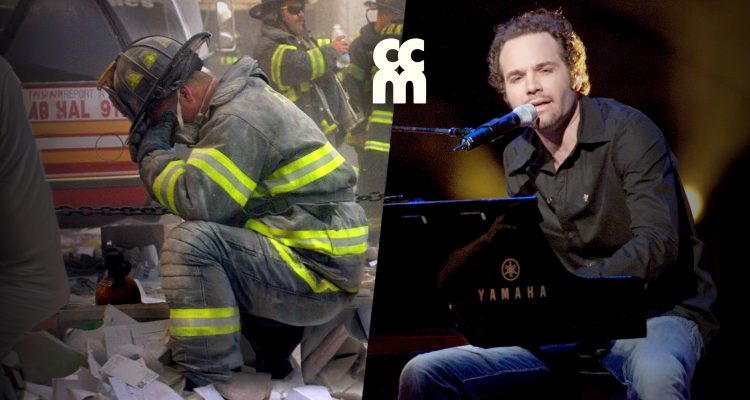
Twenty-five years later, there are still certain songs I cannot hear without being transported back to the days and weeks after September 11, 2001.
Music was everywhere. It was at memorial services. It was underneath television montages of firefighters walking through smoke and rubble. It was coming out of car radios while Americans were still trying to comprehend what had happened. Songs written years earlier suddenly meant something entirely different. Lyrics that had nothing to do with terrorism, Ground Zero or national grief were repurposed because we needed them.
We needed language for something that didn’t have words yet. Some of those songs were explicitly patriotic. Others weren’t. A love song like Enrique Iglesias’ “Hero” and the hard rock anthem of P.O.D.’s “Alive” became attached to the moment.
But one of the songs that became most inseparable from that time had already been released and was slowly climbing the charts. Five for Fighting’s “Superman (It’s Not Easy).”
I recently sat down with my friend John Ondrasik, the man behind Five for Fighting, as we approached the 25th anniversary of September 11. John and I have known each other for years, and our conversations often revolve around current events and what is happening right now. This time, I wanted to go backward. Because the story of “Superman” is really a story about what can happen when a song stops belonging entirely to the person who wrote it.
WATCH: Logan Sekulow’s full conversation with John Ondrasik
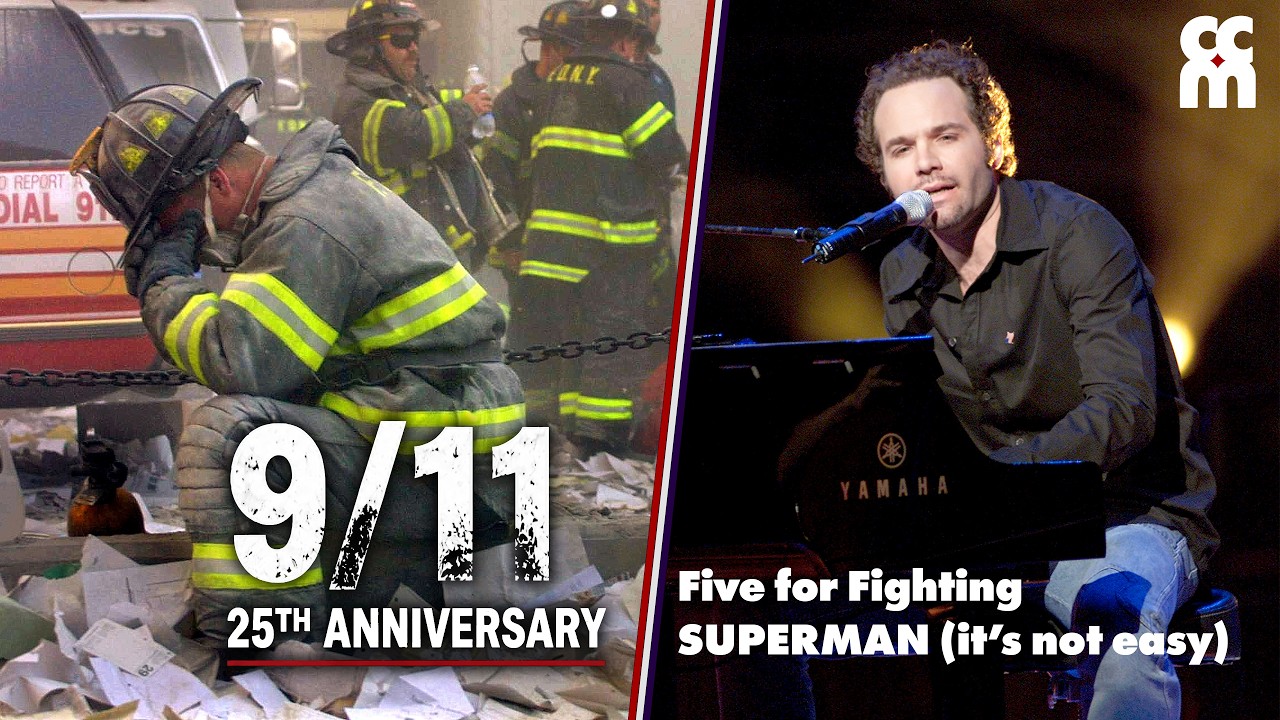
Before “Superman” became associated with firefighters and first responders, John was a young artist trying to convince his record company to release a piano ballad.
“It’s funny, I had a song called Easy Tonight that was a moderate hit, and the record company said, you get one more swing,” John told me. “And I’d seen Superman’s reaction in shows and people forget, you know, it wasn’t 1977 with the piano all over the radio. It was little boy bands, grunge music.”
The label wasn’t exactly thrilled about betting that swing on “Superman.”
“But I’m like, if I’m going down with one song, I’m going to go down with Superman.”
It worked.
The song began gaining traction, including in some unexpected places. John remembers getting a call informing him that “Superman” had gone to Number One in the Philippines.
“And I’m like, Philippines, let’s go.”
By September 2001, it was becoming a global hit. John had traveled to Europe to promote it and was in London on September 11.
“And of course, when the first plane hit, I got calls, turn on the TV, and then, like everybody else, when the second plane hit, I just started calling everybody I knew in New York City and was in shock and it took ten days to get back to the States.”
What John didn’t know was that while he was trying to get home, his song was changing. The song is about the man underneath the cape. It’s about vulnerability, responsibility and the weight of being the person everyone expects to be strong.
Suddenly America was watching real people do exactly that. Firefighters. Police officers. EMTs. Rescue workers. Ordinary people running toward something every instinct should have told them to run away from.
Television and radio outlets began pairing “Superman” with images and stories of those men and women. John wasn’t orchestrating it. He didn’t even know it was happening.
“I didn’t really realize till I got back how many news organizations have been using Superman to recognize those heroes that ran into those buildings,” he told me. “And for a young guy who just got used to hearing his song on the radio, it was pretty overwhelming.”
Nobody held a meeting and selected the official song America needed. Nobody commissioned John to write something about the terrorist attack. The audience heard something in a song that already existed and collectively gave it another meaning. John understands that now in a way he couldn’t have possibly understood then.
“It’s hard to wrap my head around it,” he told me. “Music, as you mentioned, was very critical at that time. And songs have a way of providing solace, recognizing amazing people who do heroic things, something we can all sing together.”
Then came Madison Square Garden. The Concert for New York City was one of those events that is almost impossible to adequately explain to someone who didn’t live through that period. The lineup alone was staggering. Paul McCartney. The Who. David Bowie. Billy Joel. Elton John. Eric Clapton. Mick Jagger and Keith Richards. Bon Jovi. John Mellencamp.
And suddenly, Five for Fighting.
When I first saw John perform around that era, he was playing a side stage. Then, almost overnight, he’s at Madison Square Garden surrounded by the biggest artists alive.
“It was surreal,” he said. “As you said, if it was any other day to be on the same stage at Madison Square Garden with virtually every one of my living icons, right, would have been beyond a dream come true. Of course, that wasn’t what it was about.”
John remembers arriving and finding his trailer next to The Who. He was already nervous. Then he started looking through the show’s itinerary, expecting the new guy with the piano song to be somewhere near the beginning.
“I kept turning the pages and I didn’t see my name, and I’m like, oh, good, they forgot me because I’m so nervous.”
Then he reached the end.
“And I turned to the last page and it’s like, you know, Mellencamp, Billy Joel and Elton John… five for fighting… Janet Jackson, Paul McCartney.d.”
But the famous names aren’t what John remembers most. It was the people in the audience. “When you meet the families who lost loved ones, when you stood with the firefighters, I really kind of immerse myself in that.”
These weren’t anonymous faces watching a benefit concert on television. “Those folks, virtually all of them had been down at Ground Zero, digging through rubble, for 30 days again, it gave me, a unique perspective.”
John told me the experience changed the trajectory of his career. “I think it changed, frankly, kind of the rest of my career because I saw how music truly matters.” Then he put it even more simply: “I saw how how music can really change the world and do things nothing else can.”
For John, “Superman” never completely returned to being simply another song in the setlist. Each September, it gets heavier.
“Every time we get around to this time of year, we’re typically out with my string quartet. And as we get closer and closer to 9/11, the song carries more weight.”
This year, for the 25th anniversary, he told me he plans to be in New York participating in events with firefighters, families and other heroes. But for “Superman,” September 11 wasn’t the final chapter of its story.
It was really the beginning of a song finding lives its author could never have predicted. After the October 7 attacks in Israel, “Superman” found another audience in unimaginable pain. Music had once again intersected with terrorism, grief, heroism and people desperately trying not to allow the world to forget.
John told me a new version of “Superman” began with a request from the mother of a hostage.
“We did a new version of Superman that was initiated, actually by the mother of Alon who’d been hostage over 700 days. She asked me, ‘can we do something musically to put the spotlight back on the hostages’?”
For John, the connection was immediate.
“And I thought Superman would be a good to remind folks that for our Jewish friends, October 7th is their 9/11.”
They made the video. It traveled around the world. John began showing it during his concerts. And each night he would tell the audience about one particular hostage, Alon Ohel, a gifted pianist. “At the end of every show I would say, you know, I hope and pray for the day when I can sit down and play Superman with Alon, who’s a fantastic piano player.”
Night after night, people applauded. But John admits he didn’t really believe that moment was likely to happen. “If you would have asked me, what are the odds of that? I would have said very, very low.”
And then it happened. Alon came home. And somehow this little piano song that a record company once wasn’t sure it wanted to release found itself on another extraordinary stage.
John Ondrasik and Alon Ohel sat together aboard the USS Nimitz and played “Superman” in celebration of the 250th anniversary of the United States of America. John doesn’t have a complicated explanation for what that moment meant to him.
“It was a miracle. And and I can’t I can’t say anything more. You know, miracles do exist. And that was a miracle.”
Twenty-five years earlier, John had watched his song become attached to heroes he had never met.
Now he was sitting beside a man whose story had become another symbol of survival.
“Alon would not be alive without America,” John said. “So I thought having him sitting on that deck of the historic USS Nimitz playing for me spoke to a lot of people and was very significant.”
It was a beautiful moment.

It is a full-circle story nobody could have written in 2001.
John has now played “Superman” at Madison Square Garden for the families and firefighters of September 11. He’s performed for American troops through the USO. He’s taken his music to Israel and Hostage Square. He has watched a song about a tired and human superhero become a soundtrack for actual heroes, grieving families, soldiers and hostages.
“I always thought nothing would come close to The Concert for New York,” he told me. “But, you know, playing Superman and my song Okay, at Hostage Square in Israel. Actually, the night that Iran bombed for the first time, I mean, that experience again, it’s amazing where these songs take you.”
A songwriter can tell us what inspired a song. We can analyze the lyrics. We can document where it was recorded and when it was released. But artists don’t always get to decide what their songs ultimately mean to us. Sometimes history does that.
Sometimes a song you heard a hundred times suddenly plays underneath an image you will never forget, and from that moment forward you can never hear it the same way again.
On this 25th anniversary of September 11, there will rightly be countless retrospectives about what happened that morning, the nearly 3,000 lives lost, the firefighters and first responders who ran toward danger, the families whose lives changed forever and the America that emerged from those days.
But I also hope we remember the role music played.
Because for a while, songs became our unified voice. We didn’t all know what to say. But we could listen together. We could sing together.
“I saw how music truly matters.” Twenty-five years later, I don’t think there’s a better way to say it.
Five For Fighting with his String Quartet start their Fall tour September 19th.
For Tour Dates visit: https://www.fiveforfighting.com/tour
Leave a Reply
You must be logged in to post a comment.