
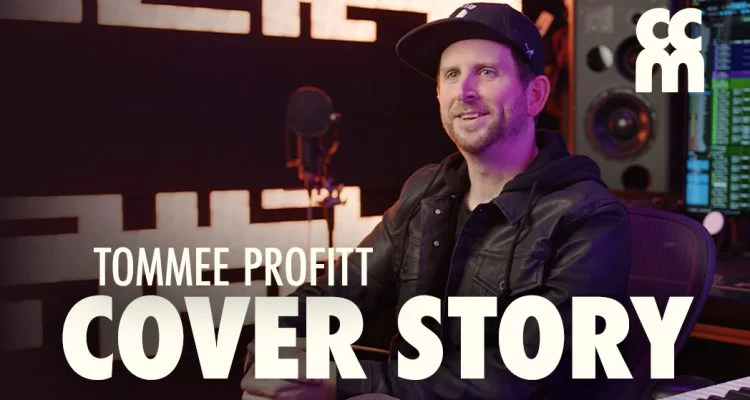
Tommee Profitt
One of One
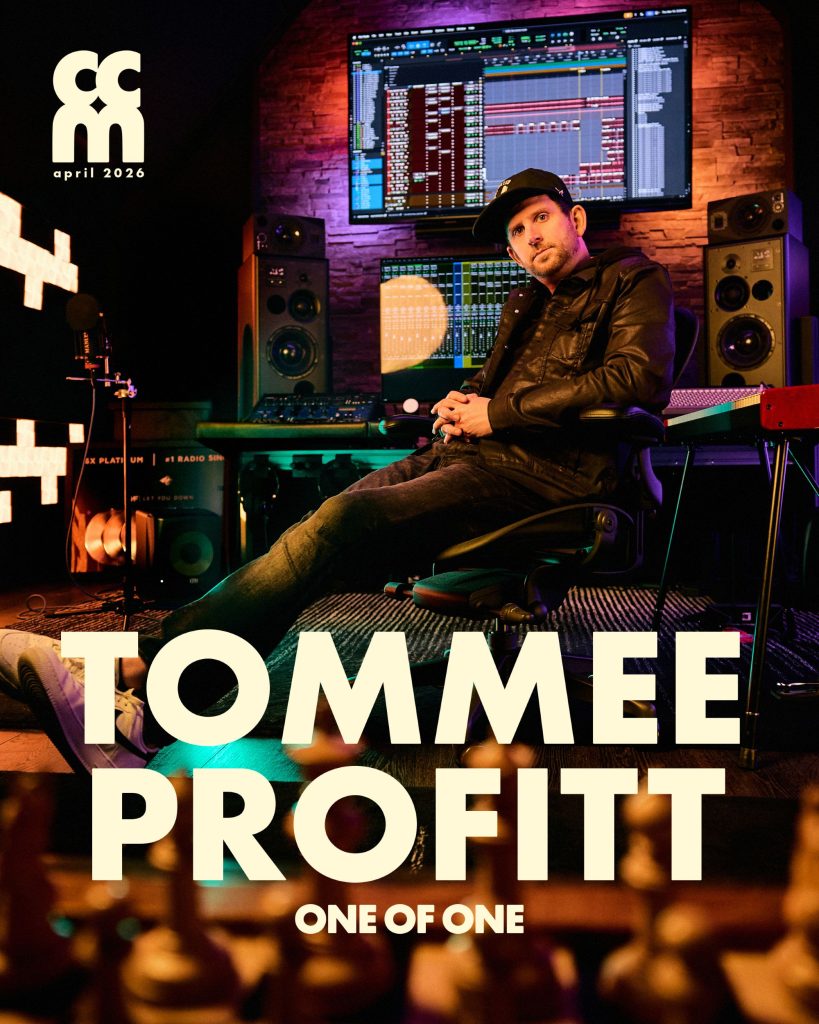
As a fellow geek and collector, walking into Tommee Profitt’s studio feels like stepping into a dream. You pass a staircase of credits lining the walls, ranging from UFC broadcasts and horror films to international versions of all of your favorite reality shows. Then comes a dark hallway featuring a plaque dedicated to his legendary Bridgestone Arena show. Past the medieval-themed bathroom, you finally enter a highly organized and deeply personal collection that feels less like a shrine to his own career and more like a tribute to the things he loves.

There are awards tied to his work and collaborations with artists like NF, but those pale in comparison to the life-sized Iron Man, two different 1:1 scale Jokers, and what feels like an endless army of Teenage Mutant Ninja Turtles. Somehow it still feels professional, slick, and …dare I say… very cool.
As heavy and dark as his music can sometimes sound, it’s clear his creative universe is rooted in nostalgia and happy memories. The room isn’t sterile or corporate. Instead, it feels like a private creative cave built for one person to disappear into for hours at a time.
Which, as it turns out, is exactly what it is.
“In my previous studio I made it neutral. I wanted everyone to feel comfortable. But when I built this one, I realized I’m in this room by myself 90 percent of the time. I wanted to make a place that inspires me, that I never want to leave.”
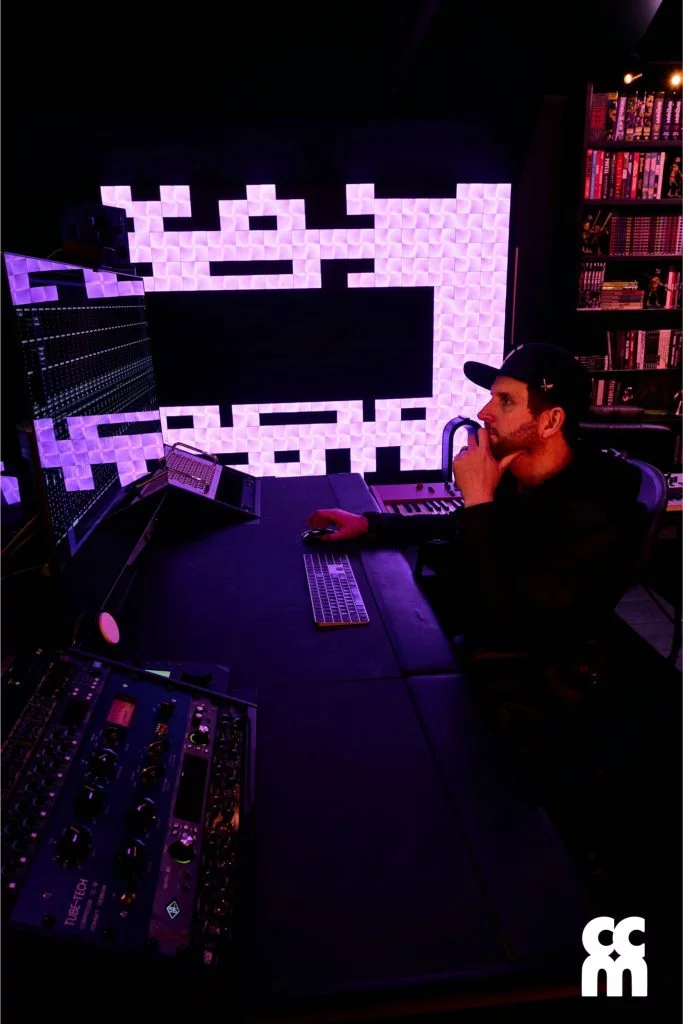
Its goal is simple: inspire the man sitting behind the 100-inch screens, often alone in the dark, building massive orchestral soundscapes that will eventually be heard by millions of people.
“I sit here and get lost in tracks for six hours and forget to eat or go outside.”
And yet somehow, this often solitary composer is filling arenas.
That’s the paradox of Tommee Profitt.
He isn’t a singer. He doesn’t tour. His music isn’t built for radio. But his compositions have generated more than 100 billion streams worldwide, appeared in hundreds of film and television placements, and somehow transformed a cinematic Christmas album into a sold-out arena experience at Nashville’s Bridgestone Arena.
“I sit here and get lost in tracks for six hours and forget to eat or go outside.”
-Tommee Profitt
Even describing it out loud sounds strange. On paper, it doesn’t make sense.
Which is exactly what makes it so fascinating. At some point I have to turn the conversation to numbers. I try to put it into perspective, explaining that most people don’t realize the difference between a million and a billion, let alone a hundred billion.
But for Profitt, the number itself feels strangely abstract. “A lot of that is TikTok,” he says with a shrug. Songs he created in this room have been used in millions of videos, spreading quickly across the internet while he’s still sitting here in sweatpants building the next track.
But when I ask him what actually feels bigger, the streams or the moment the lights go down inside Bridgestone Arena, he doesn’t hesitate.
“Bridgestone,” he says immediately. “That number [100 billion streams] is kind of like in a cloud that I hear about. But seeing Bridgestone and seeing how God put that together… that felt real.”
When Profitt released The Birth of a King, his cinematic Christmas project that reimagined familiar carols through the lens of a sweeping modern orchestra, it quickly became something bigger than a typical seasonal album. The recordings themselves were massive, full of choirs and orchestral arrangements that felt more like a film score than a collection of Christmas songs.
The idea of performing it live seemed almost impossible. After all, staging the music required a full orchestra, a massive choir, a band, and a rotating cast of vocalists. “No one had ever bought a ticket to anything I’d done before,” Profitt says. Even his own team wasn’t sure it would work. “We almost pulled the plug before we announced the first year.”
“Moses told God he couldn’t lead because he didn’t have the voice. And God gave him Aaron. I feel like God has given me these incredible singers to come alongside me.”
– Tommee Profitt
Instead, the opposite happened. Fans showed up. And then they kept showing up.
What began as a bold experiment quickly became an annual tradition, with thousands of people traveling to Nashville each December to experience it. Profitt will offer two chances to see his show at Bridgestone this year. “I truly don’t know how it happened,” Profitt says. “You can’t manufacture people traveling from all over the world to come to something like that.”
Because before the arenas, before the orchestras, before the billions of streams, Tommee Profitt was just a bored 90s kid trying to figure out how music worked.
“I used to sit in my parents’ unfinished basement with headphones on making tracks,” he remembers. Bare concrete walls. Dim lighting. Just a keyboard and a lot of curiosity.
“My parents bought me a keyboard for Christmas when I was about seven,” he says. “I didn’t even ask for it. They probably just needed another gift. But I fell in love with it immediately.”
There were no YouTube tutorials in those days. No TikTok producers explaining their process.
So he learned the way musicians used to learn: by listening. “I would hear songs on TV and try to figure them out on the keyboard,” he says. Over time the tools evolved dramatically.
“In the early days there were like 128 MIDI sounds and everyone had the same ones,” Profitt recalls. “Now you can control an entire recorded orchestra from a keyboard. For a piano player, that’s the most fun thing imaginable.”
That fascination with orchestration eventually pushed him into film scoring and production, where his music began appearing in movie trailers, television series, sports broadcasts, and viral social media moments.
“I see myself as a musician first,” he says. “Piano player, composer. Producing is just part of that.”
But long before Hollywood placements and viral streaming numbers, Profitt’s musical life began somewhere else entirely. Inside the church.
“I felt called to worship leading when I was a teenager,” he says. There was only one complication. “I didn’t have the voice,” he admits with a grin. “It was mediocre. I could get through it, but I wasn’t the singer.”
Instead, his strength was always in building the music itself—arranging songs, shaping sound, and creating musical landscapes that allowed other voices to shine.
That dynamic eventually became the foundation of his entire career.
“Moses told God he couldn’t lead because he didn’t have the voice,” he says. “And God gave him Aaron. I feel like God has given me these incredible singers to come alongside me.”
That realization sits at the heart of Profitt’s newest project, THE RESURRECTION OF A KING, a 19-song cinematic exploration of historic Christian hymns.
The album features an extraordinary lineup of vocalists, including Phil Wickham, CeCe Winans, Crowder, Jenn Johnson, Jon Reddick, Ben Fuller, Jordan Smith, Anthony Evans Jr., Bay Turner and CCM Magazine’s own recent cover artist Jamie MacDonald.
“I thought this was going to be a 2027 album,” Profitt says. Then something changed. “I felt like the vision for this album was dropped on me,” he says. Instead of taking a year and a half to build the record slowly, Profitt suddenly felt an urgency that it needed to be made immediately.
“I see myself as a musician first. Piano player, composer. Producing is just part of that.”
– Tommee Profitt
When I ask why the project had to happen now, he pauses. “It wasn’t something I was planning.”
At first he pushed back on the idea. After years of building a career scoring films, trailers, and cinematic projects in the mainstream world, suddenly pivoting into a worship record built around historic hymns felt unexpected and even risky. But the more he wrestled with the idea, the more persistent the sense of calling became.
“The world just is in desperate need of God right now,” he says quietly. Working on dark cinematic scores while watching a culture that seemed increasingly anxious and divided made the contrast impossible to ignore. “I’m up here sometimes making some dark minor cinematic version of something for a movie, and I’m looking out at the world and thinking, what should I really be spending my time on?”
If the story of the cross is the most epic story in human history, he realized, it deserved to be treated with the same cinematic weight he had spent years bringing to Hollywood. What followed was an intense creative sprint.
For six months Profitt essentially disappeared into the creative cave upstairs, working twelve- and thirteen-hour days trying to finish nineteen songs before Easter arrived. “The last six months has definitely been a sacrifice for our family,” he admits.
While the music was being built upstairs, life continued downstairs, with his wife and kids carrying the weight of the routine that allowed the project to happen. Yet he says his family understood the moment. “It feels like a mission that we’re all in together.”
Most of the album’s tracks begins with a historic hymn but is reimagined through cinematic orchestration and modern production. While the songs were refreshed, it also changed how Profitt personally experienced the Easter story.
“I think sometimes we hear these stories so often they become almost like Sunday school versions,” he says. “It made the story hit me harder than it ever had before.” One thing Profitt seems to relish most about this phase of his career is creative freedom. “If I add something that I love and they don’t like it, we take it out,” he says of his years producing other artists.
But when the project carries his own name, the rules change. “This is what I call un-dictated creativity,” he explains. “There’s no one saying turn that down or take that out.”
One song’s project file reveals more than a hundred tracks layered together. There are drones, orchestral swells, sound textures most listeners will never consciously notice. “Sometimes I get lost and I’m like, there’s no way I can do this,” he says with a laugh. “But it’s so cool, how could I not?” One of the album’s most powerful moments almost didn’t happen at all.
Just days before the deadline, Profitt woke up in the middle of the night with a sudden realization. “I woke up at two in the morning and realized I hadn’t done ‘Nothing But the Blood,’” he says. So he got up and wrote it immediately. The song eventually became one of the emotional centerpieces of the album, featuring vocalist Jeremy Rosado.
“I didn’t know Jeremy personally,” Profitt says. “But I felt like God put his name in front of me.”
Stories like that happened repeatedly throughout the process. “I truly felt commissioned to make this album,” he says. And yet despite the scale of the music, the process of creating it still begins the same way it always has.
A piano. A quiet room. And an idea.
“I just start playing melodies and building from there.”
Layer by layer, orchestral textures form. Strings. Brass. Choirs. Maybe a random laugh or helicopter sound. His excitement and passion is contagious even when I occasionally struggled understand what I was seeing built in front of me.
In recent years he stepped away from producing records for other artists so he could focus on his own creative projects. This decision opened the doors to albums like The Birth of a King and now The Resurrection of a King. “This definitely feels like a calling back into this space,” he says. But he’s not rushing to define what that means.
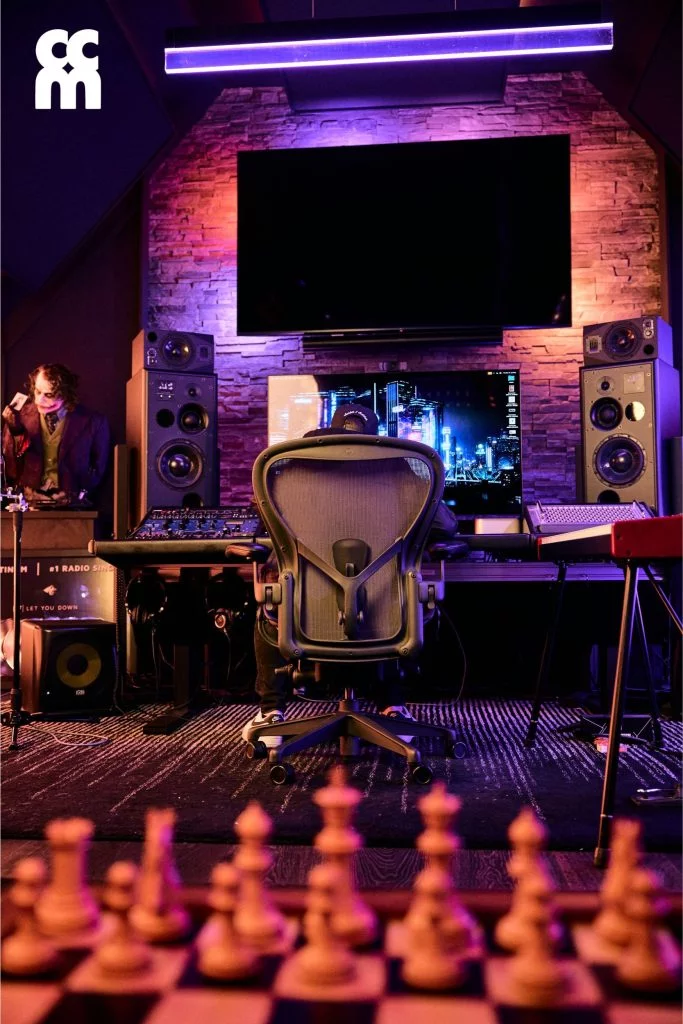
By the time we finish talking, the room has grown quiet again. We’ve all packed up our gear, but the keyboards sit waiting. The orchestra, the choir, the arena crowds that will eventually sing these songs back at him all feel a million miles away from this loft in the suburbs.
And that’s the strange truth at the center of Tommee Profitt’s career. For all the scale of what he creates, Profitt still approaches music the same way he did as a kid in his parents’ basement, headphones on, trying to figure out what might happen if he just kept playing.
The tools have changed. The audience has grown. But the process hasn’t. At its core, the story he’s telling is still the same one that has echoed through hymns for generations.
That the cross and the empty tomb are the most epic story ever told.
“I feel like I’m exactly where I’m supposed to be.”
Because in a room full of rare, one-of-a-kind items, the rarest thing might be the one sitting behind the keyboard.
Not a singer. Not a traditional artist. Not built for radio. And yet somehow, unmistakably, exactly what he was called to be.
One of One.
Leave a Reply
You must be logged in to post a comment.