
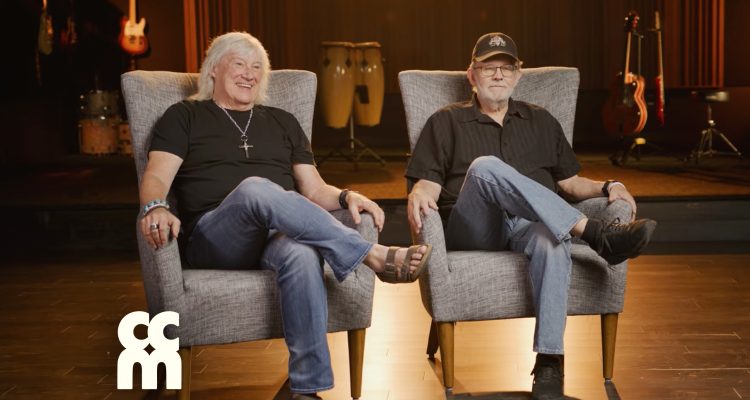
When John Schlitt and Bob Hartman sat down with me at CCM, they had perfectly legitimate reasons to be there. Beyond Belief, a new feature film built around the music and legacy of Petra, arrives in theaters August 28. The band also recently released Hope, its first studio album in 20 years. Those are both stories worth telling.
But sitting across from these guys, surrounded by old CCM covers featuring Petra through the decades, I couldn’t help thinking about the bigger story. Christian music fans and the industry should properly celebrate its legends, and of those legends Petra sits near the very top.
Not simply because they’ve survived for more than 50 years. Not because they’ve sold a lot of records, toured the world or accumulated shelves full of awards. Petra helped prove that Christian rock music could actually rock. They were doing it when Christian bookstores sometimes wouldn’t carry their albums, when churches debated whether rock music could possibly be Christian, and when there wasn’t an established career path for a band like them to follow.
There wasn’t even a roadmap for a rock band lasting 50 years. Rock and roll itself wasn’t old enough to provide one.
Yet here we are.

And somehow, after all those years, John Schlitt still walks into a room with the enthusiasm of a guy who can’t quite believe he gets be in this band and do this for a living.
That joy became one of my favorite parts of our conversation. There was something wonderfully strange about sitting with John and Bob talking about Beyond Belief while holding the June 1990 issue of CCM Magazine featuring that era of Petra.
Thirty-six years later, Beyond Belief is a movie.
The new film isn’t a Petra biopic, nor is it a traditional musical. Instead, it’s a coming-of-age story set against the world of young Christians in the 1980s, with Petra’s music running through its DNA. Songs, shirts, imagery and references are scattered throughout the film, and John and Bob even show up for a genuinely funny cameo.
When the idea was first pitched to them, however, John admits they weren’t exactly clearing space on their calendars for the premiere.
“We weren’t sure if it was going to happen because we’ve had a lot of people come up to us before,” John told me. The project kept moving. And moving. And taking years. Every so often they would hear another update. John laughed remembering the reaction: “Oh, well, Joe’s still alive. Wow. Okay.”
Eventually, however, there was an actual movie to watch. “When we finally saw the finished product… we were proud to be part of it.” The premise immediately made sense to Bob.
“When they first approached us, they said, ‘There’s never been a movie about Christianity with young people in the ’80s and what was happening with youth at that time.’ And they said, ‘We want to make that, and we want to use Petra’s music and make that part of the story.’”
For those who lived through that era, some of what happens in the movie will feel remarkably familiar. For younger viewers, it may feel almost unbelievable. There really was a time when the question of whether rock music could be Christian was being argued from church pulpits.
Petra lived in the middle of that fight.
“The people who are our age, who heard Petra in the ’80s, would have said the very things that we said in comedy,” Bob explained of their movie cameo. “There was still a lot in the church of anti-rock sentiment coming from the pulpits mainly.”
But there was another group paying attention.
“The youth leaders… always appealed to us because they were trying really hard to reach the youth. So they liked contemporary music that could reach their kids.”
That is an important part of the Petra story that can become easy to forget in 2026.
Today, Christian artists fill arenas. Rock guitars in Christian music aren’t particularly controversial. Contemporary worship music is everywhere. Christian music is a sprawling international industry.
Petra came from a world where, as Bob remembers it, “only the bravest would put a Petra record in their store.”
Think about that for a moment. The band we now rightfully regard as foundational to Christian rock once had Christian retailers refusing to stock their records. “Fans had to find the music,” Bob said. “They had to seek it out a lot more.” Maybe that’s one reason they held onto it so tightly.
Beyond Belief works because Petra isn’t simply being inserted into a fictional 1980s story as a nostalgic Easter egg. Their music really was part of the soundtrack of people’s lives. John and Bob have been hearing those stories firsthand again during Petra’s extended 50th anniversary celebration.
“If it was going to be the last album, we wanted to make sure no one said, ‘They should have stuck with the last one. Too bad they did this one.’”
“The meet and greets that we had just reminded us, this is why we do what we do,” John said.
Then he told me one of my favorite stories from the entire conversation. A grandfather approaches the band. Years earlier, he wouldn’t let his own children listen to Petra. Somewhere along the way, he discovered the music for himself. Now he’s bringing his grandchildren. The once controversial rock band became the family tradition.
John lights up talking about those encounters. “It’s just a nice reminder that God is bigger than we are, and He has a plan through the ages.”
Bob has experienced the same realization.
“Many times during the years we had to pray, ‘God, do You still want us to do this? Do You want us to keep going?’ Because there have been ups and downs and ups and downs all through those 50 years.” The answer kept coming. “Every time God has shown us He wants us to keep going.”
Then Bob said something that I think gets to the heart of why this particular season of Petra feels so meaningful. “I think maybe we’re on tour now partly because God wants us to hear some of what He did.”
John agreed. “Sometimes our meet and greets are longer than our show because so many people wanted to talk and express, ‘This is what you meant to us.’ And basically all you can say is, ‘Thank You, Jesus. Thank You for allowing us to be part of this.’”
There is something beautiful about that and the ministry of Petra decided to not just rest on 50 years of hits. After 20 years, a new project began.
When the new Petra record, Hope, arrived, I encouraged CCM readers to actually spend some time with it rather than treating it as a novelty from a legacy act. People responded.
Our story about the album became one of our most-shared pieces, with fans seemingly experiencing the same pleasant surprise: Petra didn’t simply make a throwaway record after 20 years. They made a Petra record. John says the fans themselves helped create it.
At meet and greets around the world, the same question kept coming. “Are you going to do another record?” John’s answer was essentially: no chance. Then circumstances changed. A couple of songs were needed for another project. Bob started getting ideas.
John remembers the phone call.
“He called me and said, ‘I’ve got three ideas. Can we maybe work on them?’” Three ideas became a few more. Then a few more.
“And we end up having a record.” But they were determined not to coast on the name.
“If it was going to be the last album, we wanted to make sure no one said, ‘They should have stuck with the last one. Too bad they did this one.’”
After more than 50 years, they still cared enough to be nervous about whether the record was good. Bob also recognized that the changes in the music industry that had disrupted so much of the old system now gave Petra an unexpected freedom.
For most of the band’s career, making an album required a record company willing to make a Petra album. This time, technology allowed them to do it themselves.
“We were just able to do amazing things ourselves this time,” Bob said, “and make it really a Petra record.” You can hear that freedom on Hope. There are the muscular rock songs you’d expect, but there are also unexpected turns, including reggae and other textures pulled into the Petra sound. It feels connected to the band’s history without being trapped inside it.
John thinks the 50th anniversary tour helped them understand why. “We learned a lot about what songs were really, really grabbing people,” he explained. “When you listen to the record… there are so many different sounds. They’re still new, but still familiar.”
After album titles like More Power to Ya, This Means War!, Beat the System, Beyond Belief and Jekyll & Hyde, I had to ask Bob why the new album arrived with a title as simple as Hope.
His answer was equally simple.
“We see such a need for hope in the world today. That’s really what we want to communicate, that our hope is in Jesus Christ.”
When Bob first suggested the title to John, the response took about ten seconds.
“That is fantastic.” John sees the title as more than marketing. “Christian music should be a very positive encouragement of truth,” he said. “Right now, this world needs that more than anything.”
There is another part of this story that deserves to be said plainly.
Petra is still an exceptional live band.
I saw the 50th anniversary show early in the tour, and there was no grading on a curve required. While a few new(er) faces fill out the lineup, the classic members are still at the top of their game. Bob can still play. John still has that unmistakable voice. John Lawry can still unleash the kind of keyboard wizardry that makes a crowd lose its mind.
These guys came from an era when you had to be able to play.
John seemed perfectly happy to let me keep making that point.
“I like this guy,” he laughed.
Then he turned serious. “As a singer, I can say Petra is a great band, and it really challenges me to try to keep up with them. It’s always been that way.” Being the singer of Petra, he said, comes with an expectation. “The band provides it. The singer better.”
Near the end of our conversation, I asked a question that neither Bob nor John seemed to have spent much time considering. Could Petra someday exist without them?
Not a reunion. Not another lineup change. Something larger.
Could the ministry and the idea of Petra somehow continue beyond the people who created it?
Bob wasn’t about to put limits on anything.
“I don’t want to limit God on anything because He’s already done exceedingly, abundantly above all we could ask or think.”
There are no plans.
John’s answer, however, went somewhere I wasn’t expecting, and I think it perfectly defines Petra’s legacy. “Petra, I think, is synonymous with the fact that it’s a rock ministry. It’s not just a rock band. A rock ministry.”
And in that sense, he believes Petra already continues. “There are several bands out there right now that have that same vision and that same spirit. And so it’s already out there. They’re not called Petra, but there are several bands out there doing their thing for their generation, and I’m very proud to see it.”
He’s right.
You can hear Petra’s influence in generations of Christian rock bands that followed. Artists like Skillet’s John Cooper and Disciple’s Kevin Young have spoken about what Petra meant to them. And those bands have now been around long enough to inspire another generation themselves.
That’s how a legacy becomes bigger than a catalog.
Petra kicked open doors.
Other bands walked through them.
Then they kicked open some doors of their own.
More than 50 years into Petra, the story feels less like an ending than it probably has any right to.
So I asked the obvious final question. How long does this continue? John’s answer didn’t involve a (second) farewell tour or an expiration date.
“As long as God provides, my voice provides, the opportunities — this is what we’re supposed to do,” he said. “We’re supposed to use our talents to do the commission, that’s tell the world about Christ.” Then, with the same mixture of conviction and good humor that had filled the entire conversation, he added: “There’s no such thing as retirement in the Word.”
But more than anything, this feels like a good moment for Christian music to stop and appreciate Petra while Petra is still here to enjoy the appreciation. Not as a museum piece. Not as nostalgia. Not simply because they were pioneers.
Celebrate Petra because they helped build this thing. Because they fought battles later generations never had to fight. Because they proved Christian musicians didn’t have to choose between ministry and musical excellence. Because countless artists who came afterward are standing on ground Petra helped clear.
And because, somehow, after more than 50 years, they’re still really good at being a rock band.
And thankfully, they’re not finished yet.
Beyond Belief arrives in theaters August 28. Hope is available now.
Leave a Reply
You must be logged in to post a comment.