
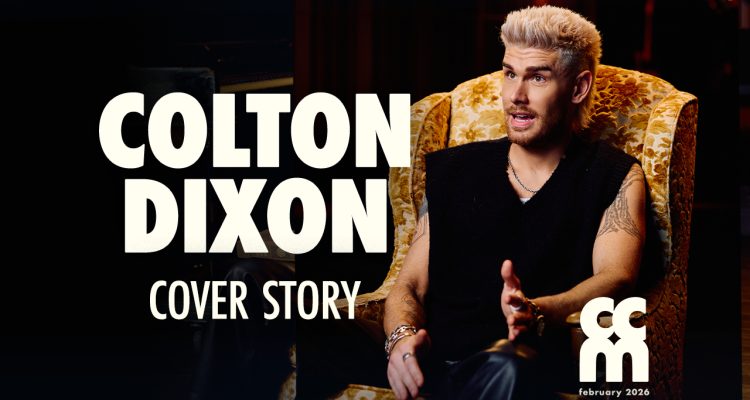
February. The month of love. Red hearts. Warm and fuzzies. A sharp contrast to the reality outside our studio walls, where a historic ice storm had brought Music City to a standstill. One that, as I am writing this, is visible out my window, where tens of thousands are currently without power.
However, when the storm arrived, my family and our cover story feature were far from Nashville. We were at Universal Orlando’s Rock the Universe, where Colton Dixon was performing to thousands of sweaty worshipers at one of the premier travel destinations in the country. As we met up a few days later in the frozen tundra of Tennessee, I think we all wished we had a little more time in the Sunshine State.


“We did the K-Love Cruise and then we did Rock the Universe. It was a crazy week last week,” Colton tells me. It was a brutal welcome home. “Thinking we might get stranded in Orlando… We wouldn’t have minded a day at Epic Universe.”
“At twelve or thirteen, I sang for the first time in public at a piano recital. I was playing one of my favorite songs at the time, ‘I Can Only Imagine’ by MercyMe.
– Colton Dixon
Colton Dixon has lived long enough in Middle Tennessee to know that storms, literal and otherwise, eventually pass. Unlike most artists who pass through Nashville with a guitar case and a dream, Colton is from here. Not “been here a while” here. Born-and-raised here.
“I grew up in Murfreesboro, Tennessee, just about thirty-five, forty minutes southeast of here,” he says. “It felt more niche, more mom and pop, more localized. We rarely ever came up to downtown Nashville for anything unless it was a show or a Predators game or something.”
It’s an increasingly rare origin story in a city bursting at the seams. Music wasn’t even the plan for the boy from the ’Boro. “When I was really young, I gravitated more towards sports,” Colton says. “I loved playing baseball and street hockey and dabbled in basketball some. But baseball was my bread and butter. I pitched, played first base, and really loved that.”
Music entered the picture almost by accident.
“At twelve or thirteen, I sang for the first time in public at a piano recital,” he remembers. “I was playing one of my favorite songs at the time, ‘I Can Only Imagine’ by MercyMe. My piano teacher set up a microphone and he’s like, ‘I feel like you need to sing this as well.’ And I’m like, ‘Hold on. I don’t think this is good for anybody.’”
Still, he did it. “I did have the guts to go out and do it and say yes,” he says. “And I believe that was the first time I encountered the Holy Spirit, which is crazy. I just knew that music was going to be a part of my story and a part of how God told His story through me.”
That moment planted something deeper than ambition. Even then, the idea of writing songs that would outlive the moment mattered. “I loved Christian music. I grew up going to Winter Jam and listening to Christian radio,” Colton says. “I’m like, that would be so cool one day to get to love on people and tell people about Jesus at my day job.” But the fork in the road came quickly.
“There came a point where it was music or baseball,” he says. “My dad coached me in baseball. It was how we hung out and spent time together.” That conversation still lingers. “My dad sat me on the couch and he’s like, ‘If you’re going to do music, the only thing that I ask is that you work just as hard at music that you did at baseball. He was big on work ethic,” Colton says. “From then on out, I was in our music room for several hours a day. I just loved it.”
The work paid off. But like many stories in Christian music, the success came early—and with it, expectations that don’t always age gracefully. “I don’t want to spend too much time on that,” I tell him when the subject inevitably turns to American Idol. And he agrees. Fourteen years later, it feels almost irrelevant. Not because it didn’t matter, but because it no longer defines him. “What’s been really cool to me,” I tell him, “is that Christian music fans seem to get over that label pretty quickly.”
“Totally,” Colton agrees. “It’s almost like once they know they can trust you and your brand or this thing that you’re building, the Idol thing goes away. It’s ‘Oh, that’s just how he got started.’ But now we know him as the ‘Build a Boat’ guy or whatever song they connected to.”

That distinction matters especially in a genre where longevity isn’t guaranteed. The proof is in the numbers. When Colton’s team casually mentions that his catalog has surpassed a billion streams, it almost feels unreal. Not just because of the scale, but because of when it happened.
“What’s even weirder is to think that probably a good chunk of those streams came from these last few years,” Colton says. “Which is incredible.”
A decade into a professional music career, most artists are fighting to maintain their place on the charts, not exploding. “I can’t really make sense of it,” he admits. “Extremely grateful is the understatement of the year.” Still, success has a way of revealing what’s underneath.
“There were definitely seasons where I was too big for my britches,” Colton says without hesitation. “Early years, but even kind of in the middle there. Just finding my footing. I had a lot of yes men around me,” he says. “Amazing people. Well-intentioned. I just didn’t have accountability.” Eventually, the weight caught up.
“I was walking on stage feeling empty,” Colton admits. “I had nothing to give.”
God still showed up. But something was off. “I realized that I can’t lead people somewhere that I haven’t already been,” he says. “It’s really important, as someone who is in a leadership position, to put in the time. And it’s not on stage. That doesn’t count.” What counts happens away from the lights. “It’s locking yourself in your room or your prayer closet or in a bunk on the road,” he says. “Wherever you need to get your Jesus time in—do the work.”

That realization marks the pivot point of this story. Not a career reset. A heart reset. And it sets the stage for everything that follows. The pivot didn’t come through radio success or chart placement. It came through a hospital room in the fall of 2020, when the world already was in chaos. Twin daughters. As a fellow dad of doubles, I understand the enormous joy, and the heightened medical realities, that come with the unique journey of welcoming two lives at once. Born into a season defined by fear, isolation, and uncertainty, but for Colton, the moment recalibrated everything he thought he knew about love, sacrifice, and God.
“I’ll never forget being in the hospital meeting my girls for the first time. There were a couple complications.” says Colton.
“Twin stuff” I reiterated. “I just remember having this overwhelming thing of like, man, there’s absolutely nothing I wouldn’t do for my girls.”
He pauses, as if the memory still catches him off guard. “I just met them. I don’t even know them. But if I needed to lay my life down right now, I’d do it.”
And then something clicked.
“The Holy Spirit just kind of gently tapped me,” Colton says. “‘I feel the same way about you.’ It wrecked me,” he repeats. “I’m a mess in the hospital.” For someone who grew up in church, who had heard about God’s love his entire life, this was different. It sounds cliche, but every Christian parent knows exactly what he felt in that moment. “That understanding—that’s how much God loves us—like that,” he says. “It truly is mind-blowing. Without kids, it’s hard to explain. Hard to understand.”
There’s a before and an after. Once you cross that threshold, everything is filtered differently, and that reframing may be what led to the chapter of Colton’s story most people now recognize.
On paper, the last few years of Colton Dixon’s career have been extraordinary. Touring more than ever. Songs connecting in ways he couldn’t have predicted. Streaming numbers accelerating instead of slowing down. “It’s been incredible,” he says while reflecting on the internal cost. “It’s wow, Colton is on the road more than he’s at home. As amazing as that is, it’s a lot to balance,” he admits. “First and foremost, I’m a believer. I want to steward my relationship with the Lord well. Then it’s family. I want to be the best husband and the best dad that I can be.” And then there’s the third layer—the vocation. “God’s given me this gift that, for some reason, He’s allowed me to use in a professional capacity,” Colton says. “And I want to steward that well.”
That balance is where tension lives. And for the first time in his career, Colton admits he felt overwhelmed. “I never considered myself to be an anxious person,” he says. “I’m even hesitant to use that word because it’s overused in the world we live in right now.” Still, something was happening beneath the surface. That’s when Romans 8 stopped being a familiar Scripture and became a lifeline.
“It’s been a life verse for me as of late. He calls us more than conquerors because of the love that He has for us,” Colton says. “That’s a really strong statement.”
He begins to laugh a bit, but with the weight of reality behind it. “Conqueror would have been just fine,” he says. “But He’s like, no—you’re more than that. Because of how much I love you. That is the love that you carry around,” Colton says. “That is the love that you operate from. You already hold the victory. The victory is already yours.”
“I realized that I can’t lead people somewhere that I haven’t already been. It’s really important, as someone who is in a leadership position, to put in the time. And it’s not on stage. That doesn’t count.”
– Colton Dixon

This shift was seismic. “Instead of constantly striving to be in a place of victory,” he says, “just operate from that place. I don’t even see myself this way,” Colton admits. “But you see me this way. Maybe I need to change the way I view myself.”
That thought became the seed for Colton’s most recent breakout single, The Love I Have For You. “It’s almost like I was talking to myself in a mirror,” he says. “God’s perspective toward me.”
In February, a month saturated with surface-level affection, Colton’s song climbs the charts with something deeper. Not romantic love. Not Hallmark sentimentality. Purely God’s love.
And it joins a string of hits that are changing people. Miracles, Build a Boat, Up + Up, and now The Love I Have For You. All of these songs are having a greater impact than he ever imagined. “I’ve had people come up to me and say, ‘That song I stood on during my battle with cancer,’” Colton says. “Or, ‘That song got me through my divorce.’”
Those moments still stop him. “It really becomes real,” he says. “This responsibility that I have. Wow. These aren’t just fun days in the studio. These are songs that could be a lifeline.” That realization shaped the room as Colton selected to perform a song not yet released for us, one that feels necessary for this moment. “You couldn’t look at social media without seeing some type of deconstruction video,” Colton says. “Someone sharing their experience with Christianity or the church in a negative way. And man, it really broke my heart.” For Colton, the pain was rooted in grief. Grief over people who had been hurt, misled, or disappointed by those who claimed to represent Christ.
“The main reason is people are putting too much of their hope in people,” he says. “Whether it be a pastor, a Christian singer, or their neighbor who says they’re a Christian. That’s not the point. People are basing their idea of who God is on an encounter they had with one of us,” Colton says. “And it’s heartbreaking.”
That tension followed him into a conversation with a close friend, Alexander Pappas. The conversation lingered and it wouldn’t let go. “I was having lunch by myself,” Colton says. “I was thinking about that conversation, and I was like, ‘Lord, there’s something to say here.’ And just boom—the chorus.” What followed surprised him. “I went into the studio with a couple of nonbelievers, actually,” he says. “And it’s funny how God does that.”
Instead of diluting the message, the setting sharpened it. The conversations were honest. Unfiltered. Human. “I’ve had some of the most beautiful conversations and songs come out of places you wouldn’t think,” Colton says. “Because it’s real.”
“The main reason is people are putting too much of their hope in people. Whether it be a pastor, a Christian singer, or their neighbor who says they’re a Christian. That’s not the point. People are basing their idea of who God is on an encounter they had with one of us.”
– Colton Dixon

The song took shape as something more than commentary on the popular deconstruction movement of millennials. “It’s kind of an open letter,” he says. “To anyone who’s been lied to, taken advantage of—fill in the blank—by a Christian.” But it doesn’t stop there. “It’s also owning up to it,” Colton says. “Man, I’m not perfect either. I’ve been the Christian who’s hurt someone before. A thousand percent. It really blossomed into kind of a prayer,” Colton says. “I pray all the time, ‘Lord, I really want to be the best example of Jesus that I can.’ Even in my failures,” he says, “I hope my wife, my five-year-old twins, the people at my shows, the barista I have a quick interaction with—I hope they find Jesus in spite of broken people like me.”
In Spite of Me asks listeners to look past the imperfect hands that delivered the message and consider the grace that still reaches for them anyway. It’s an admission that the Church is flawed. That its people are flawed. And that God, somehow, still chooses to work through all of it. In spite of us.
That weight is why Colton doesn’t talk about Christian music lightly. His role, as he sees it, isn’t to be the point. It’s to connect the dots. “We know it’s nothing we’re doing,” he says. “We’re just trying to steward what God’s given us. He gave us His promise in His Word. I’m just trying to make it catchy so you remember it.” Still, the business realities remain. “Artists don’t make their money on Spotify,” Colton says plainly. “Touring and merchandise is where artists make their money.”
Christian music, for all its spiritual weight, still functions inside an industry. “You’re touring out of necessity,” he says. “This is how I pay the bills. This is how I put food on the table.” But that reality forced another hard reckoning in 2020, when the touring world shut down overnight.
“That was a big switch for me,” Colton says. “My source of income disappeared and God was like, ‘Who’s your provider?’ My job is not my provider,” he says. “God is.”

There’s a version of the mainstream music industry where artists disappear for a while and return with something deeper to say. Christian music rarely affords that luxury. Instead, it’s built on nonstop touring, leaving little breathing room for art. It’s against that backdrop that Colton begins to articulate his frustrations, not as complaints, but as questions about sustainability, creativity, and what it really takes to make art that endures.
“There’s part of me that wishes we could simplify,” he says. “Go write songs. Live some life. Then, when the time is right, go tour.” That kind of rhythm doesn’t exist right now. But perhaps, as Christian music fans, we can begin to imagine a healthier way forward for our favorite artists.
With that being said The Love I Have For You Tour is launching this spring.
“We’re taking out my friend Tasha Layton and my new friend Bodie,” Colton says. “I’m a huge fan of both of their music styles.”
Colton has already lived a full circle career, but it seems like another lap is beginning and this one is bolder than ever. From the kid from Murfreesboro, singing I Can Only Imagine at a piano recital, now stewarding songs that carry people through their darkest moments.
It’s an easy play to reduce him to the surface. The aesthetic. The sound. The catchy choruses. But spending time with him reveals something far rarer. A man shaped by love for his wife, his kids, and his Creator. February celebrates love as a feeling. Colton Dixon is living it as a conviction.
Leave a Reply
You must be logged in to post a comment.